Eliminating Textile Failure: Why Darn Tough is the Only Permissible Base Layer
In any mechanical system, the point of highest friction is the point of guaranteed failure. Fail to lubricate a bearing and the heat destroys the housing. Put a low-grade textile between a heavy leather work boot and your foot for a minimum of twelve hours a day and the shear stress will eventually destroy the fabric.
For the vast majority of my working life—over a decade on the line in commercial kitchens and now as a service technician—I’ve spent a minimum of twelve hours a day locked inside heavy boots. The work is relentless, and the microclimate inside a waterproof leather boot is brutally abrasive. Moisture builds, friction compounds, and whatever’s against your skin takes the beating.
For years I treated socks like cheap consumables. Bought them in bulk, destroyed them in bulk. Same predictable failures every time: heel blowouts, toes sticking out of holes for Christ’s sake, elastic that gave up and let the fabric bunch and slip, which just created new friction points and blisters. Cotton and low-grade synthetics didn’t stand a chance.
Buying a twelve-pack of standard work socks isn’t shopping—it’s pre-paying for twelve guaranteed failures.
Eventually I started holding my apparel to the same standard I hold my tools. No more cheap hardware that rounds off the first time you lean on it. No more textiles that disintegrate under normal operational loads.
That pivot led me to Darn Tough. They knit heavily engineered, fine-gauge Merino wool socks right in their own mills in Vermont. Once I switched my entire base-layer inventory over, I could finally say it with zero exaggeration: these are the gold standard for foot-level structural integrity.
Field Testing: The Failure of the Alternatives
Before I made the full switch I ran every high-end alternative I could find through real-world cycles. They all came up short.
Hollow socks felt decent out of the box, but their process skips proper pre-shrinking stabilization at the mill. One wash and the heavy-duty boot sock you started with turns into something that barely reaches your ankle. Catastrophic contraction, every time. Other premium options I tried either packed out at the friction zones or simply shredded under sustained shear.
Bombas makes a structurally solid sock, no argument there. But their pricing builds in a mandatory “one purchased, one donated” charity model. I’m buying a technical garment for brutal daily use, not outsourcing my philanthropy through a corporate markup. I’d rather decide where my charitable dollars go on my own terms.
The Material Science: Merino as a Technical Asset
The core problem with most commercial socks is cotton. In a heavy boot it becomes a liability—absorbs moisture, holds it against your skin, spikes the friction coefficient, then loses what little strength it had when wet. It tears under basic shear and packs out flat.
Darn Tough uses Merino wool. In the outdoor and tactical worlds, Merino is recognized as high-performance technical fiber for a reason. The fiber is hydrophilic on the inside (pulls moisture away from skin) but hydrophobic on the outside (pushes it out as vapor). That active transport keeps the boot microclimate drier and the friction boundary stable. The natural crimp and elasticity mean the fibers spring back under compression instead of crushing and matting like cotton or cheap acrylics.
High-Density Manufacturing Tolerances
Material is only half the story. The real difference is in how it’s built.
Darn Tough runs high-density, fine-gauge knitting machines with a massive needle count. Cheap socks show obvious gaps between threads—those gaps are failure points waiting to happen. Stress hits fewer strands and they snap.
These socks knit up so tight the fabric feels like a single cohesive layer. No loose material, no excess bulk, no weak spots. The dense network spreads heel-strike friction across thousands of locked fibers. Once they’re on, they lock to the shape of your foot and stay there. No slippage, no bunching, no secondary friction on your skin.
The Ultimate QA Guarantee: Unconditional Replacement
All that material science and stitch density adds up to one simple fact: these socks are damn near indestructible in real use. But what actually sets Darn Tough apart is how they stand behind it.
Unconditional lifetime guarantee. No fine print, no limited warranty, no marketing gimmick. If you ever wear a hole in them, if they lose their fit or comfort, if they fail under normal use—you wash them, mail them back to the mill in Vermont, and they send you a new pair. No receipt needed, no questions asked. The replacement pair carries the same guarantee.
That changes the math completely. You’re not buying a consumable anymore. You’re buying a lifetime asset.
Yeah, the sticker price—around $25 for a solid heavy-duty pair—makes a lot of guys flinch if they’re used to bulk packs. But run the numbers. Five-plus years of twelve-plus hour shifts and mine are still going strong. When they eventually need it, you send them back and get a fresh pair that starts the clock over again. Cost-per-wear drops to almost nothing.
Detailed Cost Analysis: Darn Tough vs. Generic 12-Packs
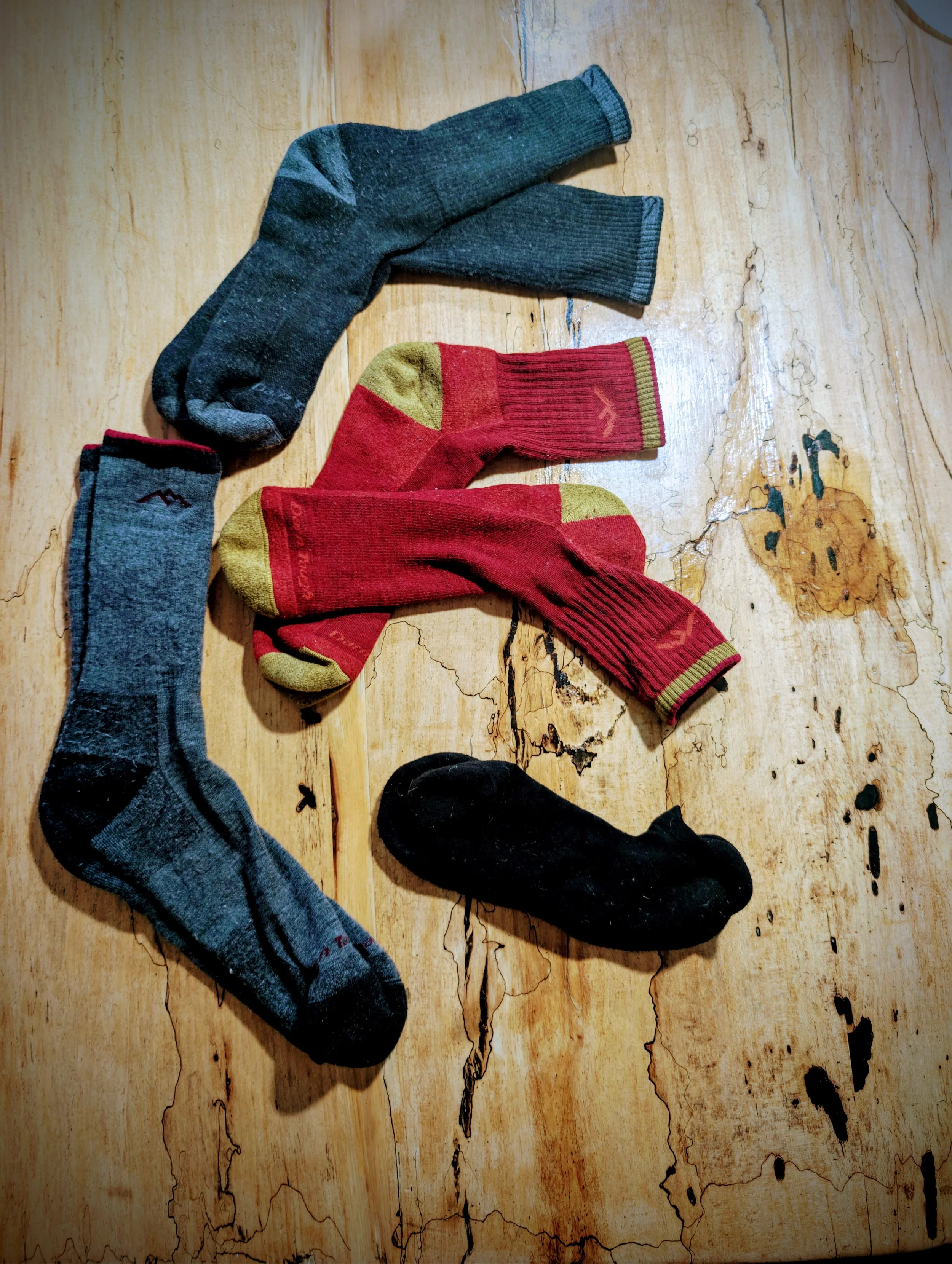
These are each a few years old.
I actually sat down and ran the real numbers instead of just feeling it in my sock drawer. Here’s the no-BS comparison using what you can buy right now.
Generic 12-pack (Dickies-style work tube socks or similar cotton blends from Walmart/Amazon): right around $16–18 for 12 pairs, or about $1.40 per pair.
Darn Tough heavy-duty boot sock (the tactical or hunting heavyweight models I run): $22–25 per pair (what I usually pay, they do have sales).
Assume you keep 6 pairs in rotation — enough to wash a couple every few days and never run short. That’s what I actually use.
Generic socks Typical lifespan in heavy boot work: 3–6 months before the predictable blowouts start. I’ll use 4 months as a fair average (matches what I saw when I was burning through them and what most guys report). With even rotation, your whole set of 6 wears out together. So you’re replacing all 6 every 4 months. That’s 18 pairs a year. Annual cost: 18 × $1.40 = about $25. 5-year total: roughly $125. 10-year total: $250. And you’re constantly stopping to buy another 12-pack, throwing out the wrecked ones, and dealing with the holes and blisters in between.
Darn Tough Upfront cost for the same 6-pair rotation: 6 × $24 = $144 (average of what I actually pay). They last 5+ years in my boots (still going strong right now). So for the first 5 years you’re looking at about $29 a year. At the 5-year mark (or whenever they finally need it), you wash them, mail them back, and they send you 6 brand-new pairs — free. The clock starts over. Years 6–10: $0. 10-year total: still just $144.
By year 6 the Darn Toughs are already cheaper than the generic route, and after that it’s pure profit. No more bulk runs to the store, no more pre-paying for failures, and zero surprise holes at 5 a.m. when you’re lacing up for another twelve-hour shift. The lifetime guarantee turns the higher sticker price into the cheapest insurance you’ll ever buy for your feet.
The Verdict on Utility
When you’re on your feet a minimum of twelve hours a day, foot health isn’t optional—it’s what keeps the whole system running. Bad socks create blisters, force gait changes, and cascade into knee, hip, and back problems. It all starts at the boot.
Switching to high-density Merino eliminates the moisture, kills the friction, and stabilizes the foundation. Darn Tough has engineered a sock so solid they’re willing to bet their entire margin on the fact that you won’t destroy it.
After years of running them through the same brutal, abrasive environments I work in every day, I can tell you the bet is sound. These are the only socks allowed in my boots.
Operational Transparency / Sourcing Note: At the time of this write-up I don’t have an active affiliate relationship with Darn Tough, though I’m in the process of setting one up. Doesn’t change a thing. I still run this exact gear standard—Benton’s Rule, pure metallurgy, materials, process, and proven longevity. Darn Tough is the required baseline in this category, commission or no commission.
