This is the first piece in a series on Misen’s pans, and it starts with the one that is no longer for sale.
Misen’s traditional nonstick skillet was, for a long time, the answer we gave when someone asked which coated pan to buy. Not because coated pans are exciting — they are the most disposable category in the kitchen — but because Misen attacked the specific way coated pans fail. Coatings rarely wear out evenly. They lose adhesion, blister, and flake, usually starting wherever the primer underneath them gives up. Misen’s response was to spend the engineering money under the coating instead of on top of it.
The construction
The body is thick aluminum — the honest material for a nonstick pan, because the job here is even, responsive heat under a surface that can’t take high temperatures anyway. Aluminum spreads heat sideways, which is what keeps eggs from cooking in a ring over the burner.
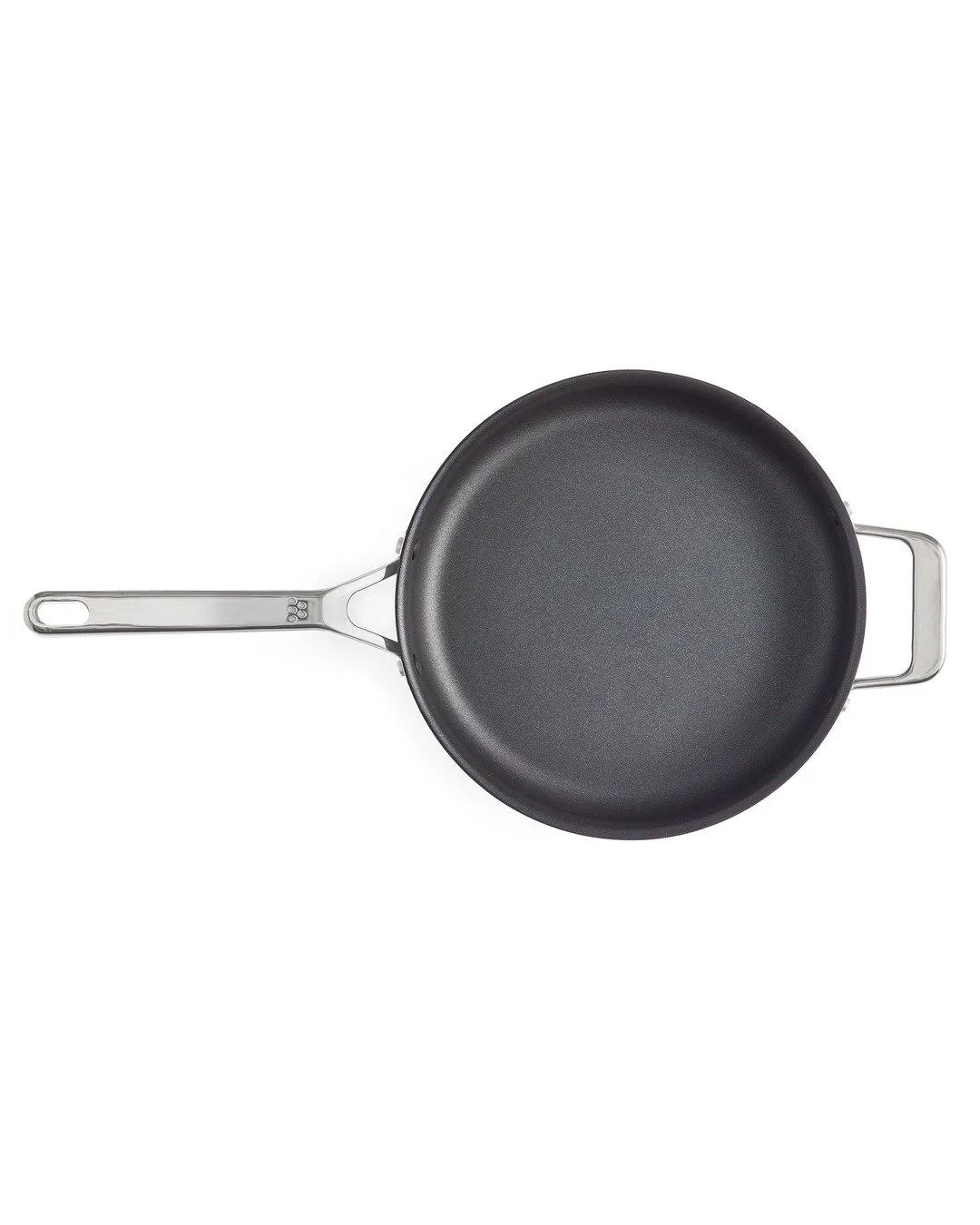
On top of that body sat a 3-layer, PFOA-free PTFE coating (DuPont’s Platinum grade), and underneath the coating sat the interesting part: a titanium-infused plasma primer. Plasma spraying roughens and keys the metal surface at a microscopic level, and the titanium in the primer gave the coating a harder, more durable layer to bond to. Most nonstick failures are adhesion failures. This pan was designed around that fact, and it is why it held its release longer than the thin, cheap coated pans it competed with.
The skillet came in 8, 10, and 12 inches, was induction compatible, and was oven-safe to 450°F, with a stainless-steel handle. A later redesign added a ceramic exterior coating for easier cleanup.
The honest drawbacks
Start with the category, not the brand. A PTFE surface is a wear item. However good the primer is, the coating is a polymer film being scraped, heated, and washed, and its release properties decline from the first year onward. When a coated pan is done, the whole pan is done — there is no re-seasoning it, no resurfacing it, the way there is with carbon steel or cast iron. That is the standing trade-off of every nonstick pan, and this one never escaped it.
The 450°F oven ceiling is the second limit. It is fine for finishing a frittata. It rules out the high-heat work — hard sears, broiler finishes — that stainless and carbon steel shrug off, and it caps how aggressively you can preheat.
The third drawback is the news: Misen has removed the pan from its lineup. Check the cookware collection today and the nonstick position is held by Carbon Nonstick, a coating-free nitrided carbon steel pan; the old nonstick product page now points there too. If you own the traditional nonstick and it dies, there is no buying another one — your replacement decision is the rest of this series.
Where the series goes from here
Misen’s current lineup is a useful cross-section of the whole pan question. The 5-ply stainless (3.0 mm, oven-safe to 800°F) is the buy-it-for-life searing tool. The Carbon Nonstick is the coating-free experiment — nitrided carbon steel over an aluminum core, heat-safe to 1100°F, hand wash only. Each gets its own teardown in this cluster, and the cluster closes with the two nonstick approaches head-to-head: the coated pan Misen used to sell against the coating-free pan it sells now.
Verdict
Judged on materials and construction — the only way we judge anything here — the traditional nonstick was the coated pan done about as well as a coated pan can be done: real metal underneath, a serious primer, an honest coating. It was still a coated pan, with a coated pan’s lifespan and temperature ceiling, and now it is a discontinued one. If yours is still releasing cleanly, cook on it and start thinking about what material replaces it. That decision is what the rest of this series is for.
Next read: the Gravitas teardown — the Misenware pan sitting on that scale is where this series started.
