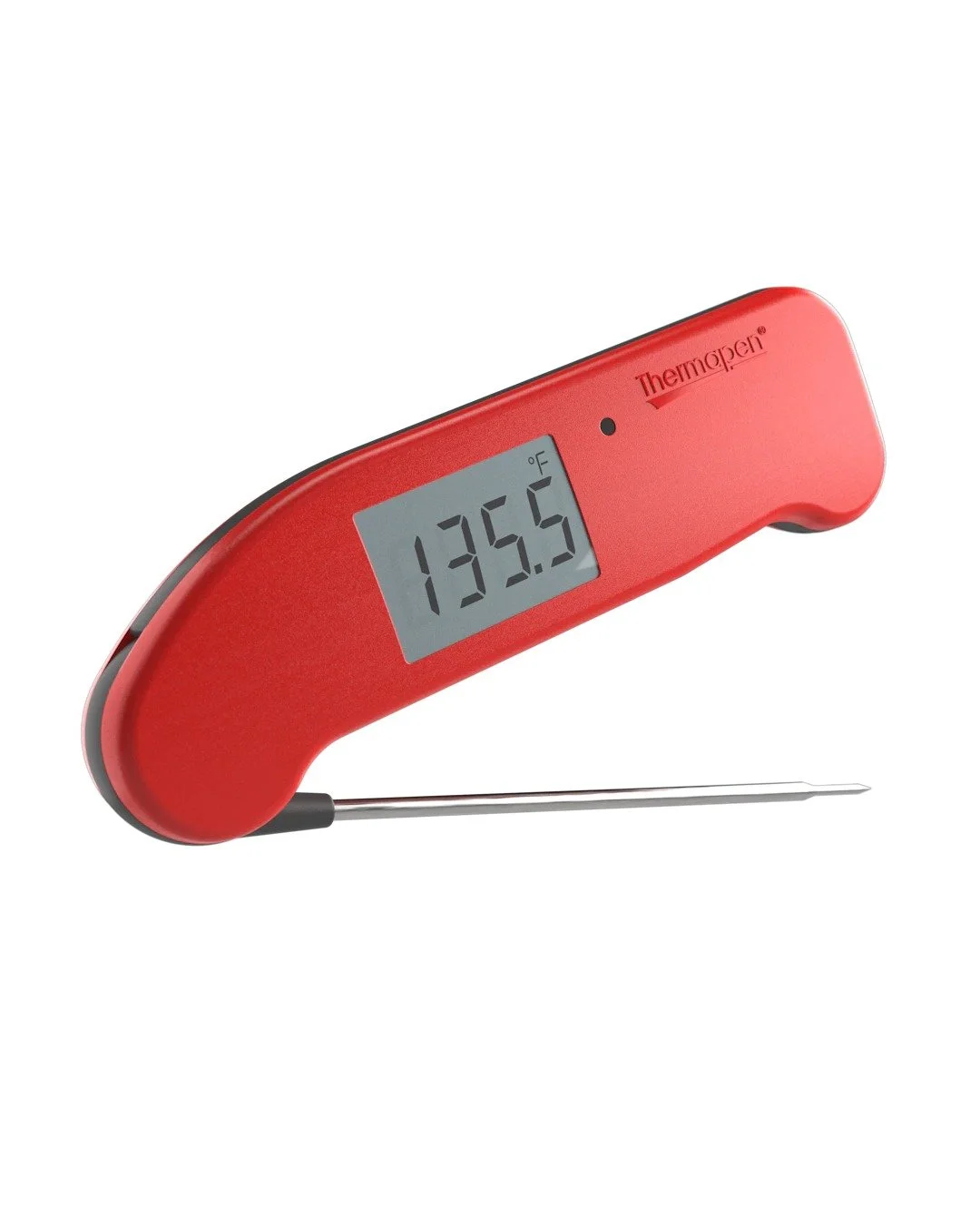
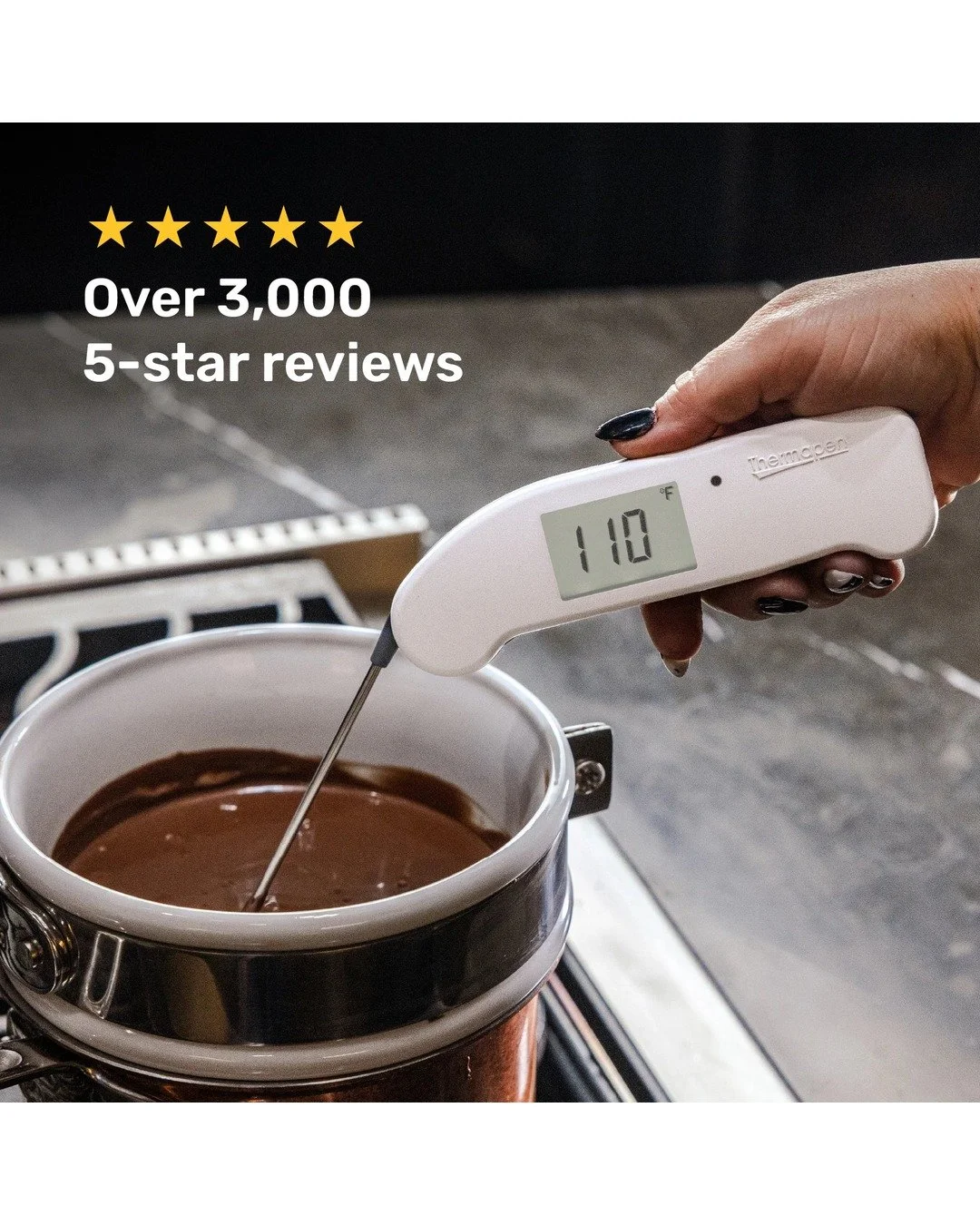
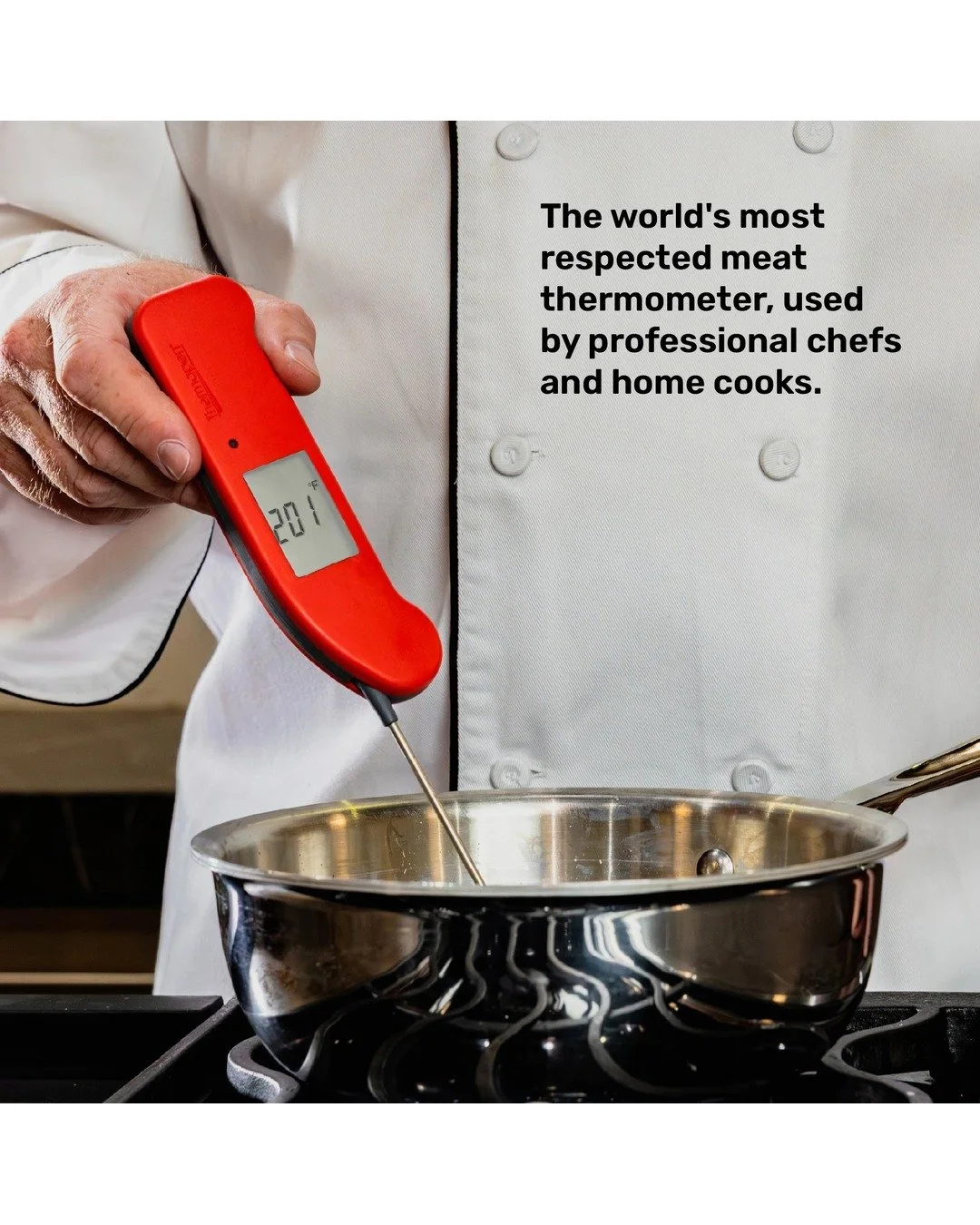
For years, the Thermapen ONE was the default answer to a straightforward question: what is the best instant-read thermometer? ThermoWorks calls it the fastest, most accurate, and most recommended cooking thermometer it makes. Strong language, but the specifications mostly back it up. Now the company is saying goodbye to the model. The ONE is on closeout at $74, down from $115, while remaining stock lasts. That price can change, and the model is being discontinued. What follows is a teardown of the tool that set the benchmark: what its specs actually mean, where it falls short, and whether the closeout price makes it the right buy.
The headline numbers
Taken straight from ThermoWorks:
Full temperature reading in 1 second
Accuracy of ±0.5°F (±0.3°C) from -4 to 248°F; ±1.8°F (±1.0°C) outside that range
Type K thermocouple probe, 4.3 inches long, 0.12 inch diameter stepping down to a 0.06 inch tip
Measurement range: -58 to 572°F (-50 to 300°C)
IP67 waterproof rating
360° auto-rotating display with automatic backlight
Motion-sensing sleep and wake; unfolding the probe turns it on, no buttons involved
One AAA battery, rated for 2,000 hours
NIST-traceable calibration certificate included in the box
5-year warranty
Why one second is not a gimmick
Most inexpensive instant-read thermometers use a thermistor, a resistor whose resistance shifts with temperature. It works, but the sensor has thermal mass, and you end up standing over a hot grill waiting for the number to settle while your hand cooks.
The ONE uses a Type K thermocouple instead: two dissimilar metals joined at a junction inside the probe tip. A temperature change at the junction produces a tiny voltage, and the meter reads that voltage essentially instantly. The 0.06-inch tip is the other half of the equation. Less metal at the sensing point means less heat to absorb before the reading stabilizes. There is no software trick here, just a fast sensor with the thermal mass engineered out of it.
What ±0.5°F actually covers
Accuracy figures are easy to inflate, so the fine print matters. ThermoWorks rates the ONE at ±0.5°F, but only from -4 to 248°F. Beyond that band, in a deep freezer or in oil at full fry, the rating relaxes to ±1.8°F. Read honestly, the tight tolerance covers every temperature that matters in cooking, from frozen solid to frying.
Each unit ships with a NIST-traceable calibration certificate. That means the thermometer was verified against a reference that chains back, through documented steps, to a national standard. For a home cook, that is reassurance. For anyone cooking professionally, it is paperwork that means something.
The probe
The probe is 4.3 inches of stainless steel that folds flat into the body for storage. It steps down from 0.12 inch to 0.06 inch at the tip. A thinner tip means a smaller hole in the meat and less juice lost, and it also means less metal to heat up before the reading stabilizes. The probe is the on switch: unfolding it wakes the thermometer, folding it away puts it to sleep. There are no buttons to find with greasy hands.
The display
The display measures 1.9 by 0.94 inches and rotates a full 360 degrees, so it reads upright whether you are left-handed or right-handed, probing from above or from the side. An automatic backlight kicks in when the light drops, which is exactly when you need it: checking a brisket at night, reading a roast in a dim oven.
IP67, translated
The IP67 rating breaks down into two digits. The 6 means dust-tight, no ingress. The 7 means the unit survives immersion in 1 meter of water for 30 minutes. In kitchen terms: rinse it under the faucet, use it in the rain, drop it in a stockpot by accident. It is not a dive watch, but it is sealed against everything a kitchen will do to it.
Power: one AAA, 2,000 hours
One AAA battery powers the ONE for a rated 2,000 hours. The motion-sensing sleep and wake does the heavy lifting here: set it down and it sleeps, pick it up and it wakes. There is no power button to leave on, no battery to drain because you forgot.
The honest drawbacks
Three things worth saying plainly. First, the list price. At $115, the ONE is serious money for a thermometer, and it is fair to ask whether a $15 dial thermometer does the job. It does not do this job, but the price still stings. The closeout largely resolves this.
Second, there is no hold button. The display shows the live temperature, which starts falling the moment you pull the probe from the meat. You read it while it is in, or you miss the peak. Most users adapt in a day. It is still a missing feature on a premium tool.
Third, this is a single-purpose precision instrument. It is not a leave-in probe, not a timer, not a cheap backup you toss in a drawer. If you want one tool that does everything, this is not it. If you want the fastest, most accurate instant-read, it is.
The closeout
ThermoWorks has marked the ONE down to $74 from $115 and says it is time to say goodbye to this model. Something new is coming, and this one is being discontinued. Prices can change, and when the stock is gone, it is gone. At $74, the value calculation flips completely: the best instant-read thermometer you can buy, at a price that undercuts most of its slower competition.
Verdict
The Thermapen ONE earned its standing the hard way: a Type K thermocouple that reads in one second, an accuracy spec backed by calibration paperwork, a probe thin enough to matter, and a body sealed to IP67. It has no hold button, it was no bargain at list price, and it makes no compromises where it counts. At the $74 closeout price, it is the easiest recommendation in its category.
Find it at https://www.thermoworks.com/products/thermapen-one
